Search
Buying Guide

Garage Buying Guide

What to look at before you buy a metal garage: roof styles, sizing, framing gauge, certification, colors and site prep. Written by the Carport Central building specialists who quote these buildings every day.

Free quotes, no obligation
Start Here

What to consider when buying a metal garage

What are you putting in it, now and in five years?

Count the vehicles, then count everything else. Bikes, mowers, tools, seasonal storage and the workbench all take floor space, and a garage sized to the cars alone fills up immediately.

Measure your widest and tallest vehicle and add three to five feet of clearance for doors and movement. If you are choosing between two widths, take the larger one. Widening a building later costs far more than the extra two feet does now.

Where will it go, and is that spot actually level?

This is the question that delays the most installations. Your site has to be level across the entire footprint of the building, within about three inches front to back and side to side. Ground that looks flat, is close enough, or slopes just a little is the most common reason a crew has to reschedule.

You also need room to work. Plan on at least three feet of clear, level space around the whole perimeter, and remember the crew arrives with a dually pickup and trailer that runs fifty five to seventy feet long, so there has to be a path in.

Does your county require a certified building?

Most buildings require a permit, and the only way to know what yours needs is to check with your city or county before you order. Some areas require every structure to be certified, some only certify occupied buildings, and some do not require it at all.

If yours needs to be certified, tell us before installation day so the blueprints are in your hands ahead of the crew. Send us your zip code on a quote and we will tell you what your county asks for.

What is the weather like where you live?

Weather should drive the roof style and the framing gauge. Heavy snowfall or wind driven rain is a reason to choose a vertical roof and step up to 12 gauge framing rather than discovering the limits later.

In high wind areas, anchoring to a concrete slab is the most secure option available.

Which doors and windows do you actually need?

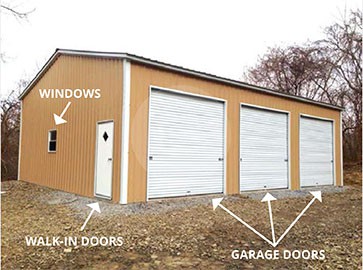
Garage doors, walk-in doors and windows are all far cheaper to specify now than to add on a return trip. The critical one is height: a structure that is not tall enough cannot take a garage door later without being rebuilt.

If there is any chance you will want a door added down the line, order the height for it now.

Not sure which of these apply to the building you have in mind?

Get My Free Quote
Compare the Three

Roof Style

The roof is what stands between your vehicles and the weather, so it is worth matching to your climate rather than your budget. All three roof styles can be certified for structural integrity, and all three are structurally sound. What separates them is how they shed snow and rain, and how they handle length.

As a rule, the more severe your weather and the longer the building, the more the vertical roof earns its extra cost. We recommend a vertical roof on any building longer than 36′.

Vertical Roof Style metal garage

Vertical Roof Style Best

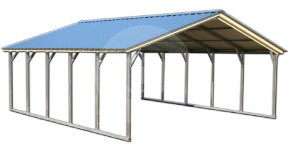
If you live in a climate with heavy snowfall or heavy rain, Carport Central recommends the vertical roof style. The vertical roof panels allow snow and rainwater to exit off the sides. This is an A-frame designed roof with panels installed vertically, with the corrugated ridges running from the highest point on the roof down the side of the building. We also recommend that all buildings longer than 36’ use a vertical style roof.

Want a straight answer on which roof style is worth it for your area?

Get My Free Quote
Get the Dimensions Right

Choosing the Right Size for Your Needs

Width

Width is the measurement people most often get wrong, because it is easy to size for the vehicle and forget the space you need to open a door and walk around it. Measure your widest vehicle, then allow three to five feet of clearance for doors and movement.

Metal garages come in standard widths of 12′, 18′, 20′, 22′, 24′, 26′, 28′, 30′, 32′, 36′, 38′ and 40′. As a rough guide:

  • 12′ a single car or truck
  • 18′ two compact cars
  • 20′ two midsized cars
  • 22′ two full sized cars, trucks or SUVs
  • 24′ two full or oversized cars or trucks
  • 26′ three midsized cars or trucks

If you are weighing two widths, take the larger one. Widening a building later is far more expensive than ordering the extra two feet now.

Length

Length is set by how much you are storing and what else has to live in the building alongside the vehicles. Metal garages start at 21′ and run 26′, 31′ and up in 5′ increments, and can be customised to the length you need.

A single midsized car fits comfortably at 21′. A two car garage is typically 25′ to 30′ long, and a three car garage or a large workshop usually lands in the same range at a greater width. If the garage is also holding bikes, sports equipment, a workbench or seasonal storage, add length rather than trying to work around it later.

Side Height

Garage height is measured by the side height, which is the height at the sides of the structure rather than the peak of the roof. Side height is what determines whether a vehicle clears the lowest point of the building, so it is the number that matters when you are checking fit.

Measure your tallest vehicle and add three to five feet of clearance. As a general guide, cars and SUVs need 7′ to 9′, RVs and boats need 12′ to 14′, and larger equipment needs 16′ or more.

The standard side height is 6′, increasing to 8′ on any structure 32′ or wider. If there is any chance you will add a garage door later, order the height for it now. Raising a building after installation is not a small job.

Tell us what you are parking or storing and we will size it for you.

Get My Free Quote
Frame Strength

Steel Gauge Framing

What Is the Difference between 14 Gauge and 12 Gauge Framing?

The framing is the skeleton of the building, and it comes in two gauges. The lower the gauge number, the thicker and stronger the steel.

14 gauge is the economical option and the industry standard, measuring 2 1/2″ x 2 1/2″. It is the most nationally accepted gauge for metal structures and it is structurally sound for the majority of installations.

12 gauge measures 2 1/4″ x 2 1/4″ and carries a higher tensile strength, which translates into higher snow load and wind load ratings. We recommend 12 gauge for areas with heavy snow and high winds, and for any structure 10′ or taller.

Both gauges are structurally sound and both can be certified. All of our gauge options can be certified, but we can only offer our extended warranty when you select the 12-gauge steel option.

Not sure which one your build calls for? Send us your zip code and what you are storing, and we will put the right gauge on the quote.

Not sure which gauge your build calls for?

Get My Free Quote
Permits and Engineering

Certification Considerations

Certified vs Non-certified Buildings

A certified building has been designed by an engineer and carries ratings for wind and snow load. A non certified building is the same structure without that engineering package, and it costs less.

Which one you need is decided by your local building department, not by us. Some states do not require certification because heavy snowfall and high winds are not a concern. Others require every new structure to be certified. Some inspect all structures, while others only inspect buildings people will live or work inside. Most buildings will require a permit of some kind, so check with your county or city before you order.

Two things worth knowing. There is no additional warranty on a certified building: certification means the structure is built to specification and certified by a professional engineer to meet local requirements, nothing more. And if you do need certification, you will likely need a copy of the blueprints for your inspector, so tell us before installation day and we will get them to you ahead of the crew.

Site preparation matters here too. The ground must be level and any concrete or asphalt pad must be wide enough to support the building and its anchors.

Tell us where the garage is going and we will check what your county requires before you order.

We can check what your county requires before you order.

Get My Free Quote
Design Choices

Enclosing the Garage

Closing both sides and panel type options

A metal building fully enclosed will help protect the items you want to store from driving rain and harsh winds. We offer panels 3’ wide in a variety of lengths, which can either be installed vertically, or horizontally to suit your needs. If you already have one of our custom carports and wish to enclose the sides and turn it into a metal garage, contact us to learn more.

Outline closing front end and back end

All our garages are enclosed metal buildings, meaning when you order a garage we know that you will need a fully enclosed building wide enough to provide security and further protect your vehicle from the elements. Tell us on a quote what you want the garage to do and we will spec the enclosure to match. Don’t want it fully enclosed but you still want the feel of the garage? If you are thinking about only enclosing one end, contact us for information on pricing.

Want this laid out for your property?

Get My Free Quote
Upgrades

Additional Options

Additional options can be added to customize the carport for particular situations.

Most of what makes a garage genuinely useful is decided at order time. These are the options worth thinking about before you buy, because several of them are far cheaper to include now than to retrofit later.

Windows

30″ x 30″ is the standard size and can go on any portion of an enclosed garage. Other sizes are available but vary by location, so ask us what is offered near you.

Walk-in doors

A walk-in door saves you opening the main door every time you need something. They come with or without a window, in a white finish, and can be added later if you enclose a carport into a garage. Tell us at order time if you do not want the window.

Insulation

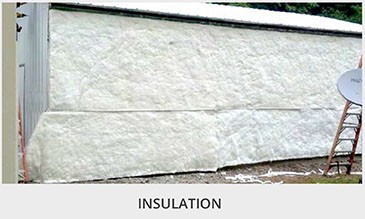
Worth it if you are storing classic or temperature sensitive vehicles, or using part of the garage as a workshop. We install bubble insulation with an R-value of 4.3, which limits condensation and keeps most of the heat from escaping.

Panels

Panels are 3′ wide and available on 21′, 26′, 31′ and 36′ lengths. They are how an existing carport gets closed in and becomes a garage, so they are also the route if you want to start smaller now and enclose later.

Bows and trusses

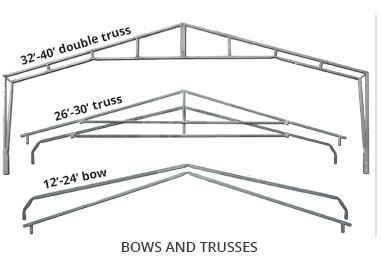
These are the structural supports inside the roof and along the sides that add strength and stability. Garages up to 24′ wide have a bow, and anything wider than 24′ has a truss. In areas with heavy snow or intense weather, extra bows or trusses are worth adding.

Anchors

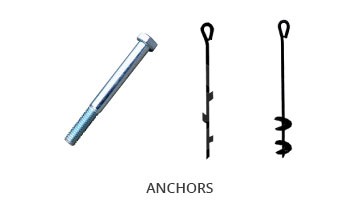
Anchors are what hold the building down in high wind, and the right type depends on what you are anchoring into. Concrete, asphalt and ground each take a different anchor, so this one is decided by your foundation.

Send us the options you are considering and we will price them into the quote so you can see what each one actually costs.

Optional upgrade for a metal garage 1
Optional upgrade for a metal garage 2
Optional upgrade for a metal garage 3
Optional upgrade for a metal garage 4

Send us the options you want and we will price them into the quote.

Get My Free Quote
Make It Yours

Colors

Choose your color, and the steel that carries it

Roof, sides and trim are specified separately, so you can match the garage to your house instead of settling for one flat color. Click any swatch for a closer look.

Color is tied to the gauge of the panel steel, and the two gauges carry different warranties:

  • 29 gauge carries a warranty of up to 20 years against chipping and cracking.
  • 26 gauge is heavy duty steel with a warranty of up to 40 years against fading, and offers industrial strength resistance to weather while still suiting residential designs.

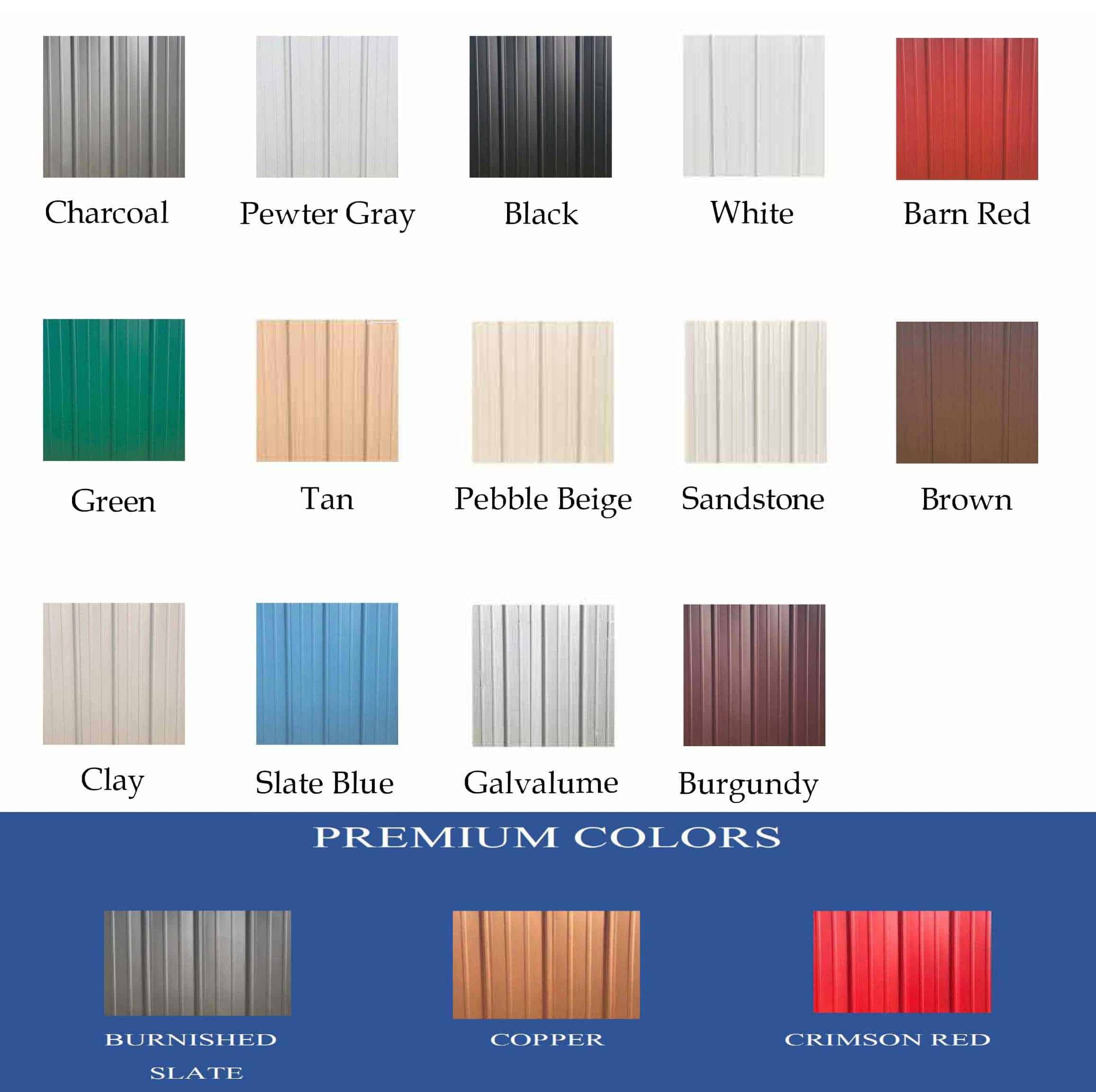
Standard and specialty colors are available in both 29 and 26 gauge, and cover the full range from whites, beiges, sandstone, clay and tan through the reds, grays, browns, blues, greens, black and galvalume.

Premium colors are available at extra cost. Royal Blue is a premium color and is not available in 26 gauge.

Availability varies by region, so send us the colors you are considering and we will confirm what is available near you and show you the combination on a real building.

Color options for a metal garage

See These Colors on Real Buildings

Tell us the colors you are considering and we will show you the combination.

Get My Free Quote
Before We Arrive

Installation and Site Prep

What “level” actually means

Unlevel ground is the single most common reason installations get postponed. For a metal structure, level means level across the entire footprint of the building, within about three inches front to back and side to side, and square. Not “it looks flat”, not “it slopes just a little”, not “it is close enough”.

It matters because the consequences are permanent. An unlevel footprint causes doors and windows that will not operate properly, visible gaps in the panels, and water or pest intrusion. It can also void the manufacturer’s warranty. On a garage, where the doors have to seal and operate every day, it shows up faster than on an open structure.

Level under the building, sloped away around it

The ground directly under the structure must be level. The ground surrounding the footprint should slope away from it, so water runs off instead of pooling at the base. Proper grading is what prevents standing water, soil erosion and foundation shifting over the life of the building.

What you are responsible for

Site preparation is the customer’s responsibility. Our crews assemble the building. They do not grade, level or excavate. Before installation day you need to have:

  • Obtained any permits your city or county requires
  • Checked zoning regulations and property setbacks
  • Called 811 to have underground utility lines marked, which is free
  • Cleared all debris, vegetation and overgrowth from the site
  • Left at least three feet of level clearance around the entire perimeter
  • Prepared and compacted the gravel, asphalt or concrete base

If a lift is needed for your build, that clearance goes up to ten feet clear of obstructions.

Access for the crew

The installation crew arrives with a dually pickup and attached trailer that totals fifty five to seventy feet long. Remote sites, steep hills and locations far out into a field can be genuinely inaccessible. If there is more than a fifty foot gap between where the truck can park and where the building goes, there may be an additional service fee for the extra time.

If your site requires safety training, an orientation or a safety video before anyone can work on it, tell us when you purchase so it can be noted on the purchase order. Depending on the length of the requirement, a fee may apply.

What happens if the site is not ready

The installation is postponed. Any grading or levelling then needed is done at your expense, crew availability shifts, and the project timeline extends. Getting the site right ahead of time is the cheapest part of the whole process.

Choosing your base

A concrete slab is the strongest and most durable option. It prevents shifting, is easy to clean, and is the right choice for garages, workshops and anything you intend to certify. Gravel is affordable and drains well, which suits carports, RV covers and smaller storage, provided it is properly compacted and level. An asphalt pad is smooth, stable and cheaper than concrete, and works for carports and small garages, though it does not hold up as well under heavy use.

Not sure your site is ready? Send us photos and measurements on a quote and we will tell you what still needs doing.
Not sure your site is ready? Send us the details and we will tell you.

Get My Free Quote
Common Questions

Garage FAQs

I know I want to add my own window or custom door to a custom building; can you help me with that?

We will not install customer supplied windows or walk-in doors, but our technicians can frame out the openings so you can complete the installation yourself. That covers windows, walk-in doors and garage doors.

The important part is ordering the garage with the height and width to take them, so tell us at order time and we will make sure the structure fits what you plan to install.

What do I need to do to prepare for the installation?

This is a question frequently asked by first time buyers. To make sure the metal garage is installed as safely and as secure as possible, it is important to prepare the surface and the foundation on which that the carport or structure will rest. The surface must be flat and easily accessible. For all custom metal buildings, we recommend the foundation be level within 3” from left to right and front to back. Be sure to remove any debris or vegetation from the area as well. You can read more about how to prepare for installation by visiting our blog.

Could you make additions to the garage after it has already been installed?

Yes, though it is worth understanding the cost. Coming back out means a service charge for the return trip on top of the price of the new item, and we only install Carport Central products.

The bigger constraint is height. A garage door cannot go on later unless the building was ordered tall enough for it, so tell us now if it is a possibility. In most cases ordering everything up front is meaningfully cheaper than adding it in stages.

Is there a way I can build my garage in stages to save on cost?

Yes. A common route is to buy a carport first and add panels and doors later to enclose it into a garage. It works, provided the original structure is sized and specified for what is coming.

Budget for the second installation of the panels, walk-in door and garage door as a separate cost. Tell us the end goal on your quote and we will size the first stage so the second one actually fits.

Why should I add insulation to my garage?

No matter how you intend to use your custom metal building, it’s a good idea to include a vapor barrier. We provide and install a number of moisture barrier options, including:

1. Single-bubble vapor barrier

2. Double-bubble vapor barrier

3. Prodex-equivalent vapor barrier

4. Pre-installed DripStop moisture control system

If temperature control is also a priority for your building application, you’ll also want to add some thermal insulation like spray foam, rigid board panels, or fiberglass insulation. If you have questions about which moisture control and climate control options are right for your new metal building, just connect with one of our friendly building specialists and we’ll be happy to help.

What can I customize on my new metal garage?

Width, length and side height are all made to order, and the roof style, framing gauge, and the colors of the roof, sides and trim are chosen separately. Beyond that you can add windows, walk-in doors, garage doors, insulation, extra bows or trusses, and the anchors suited to your foundation.

Not every color is available in every location, so send us what you have in mind and we will confirm what is offered near you.

What are my custom metal garage color options?

The roof, sides and garage doors are all specified separately, so the building can be matched to your house rather than ordered in one flat color. Windows and doors come in white trim.

Color availability varies by region because it depends on the panel steel stocked near you. Send us the colors you are considering on a quote and we will confirm what is available in your area.

Still have a question we have not answered here?

Get My Free Quote
Next Step

Ready to Price Your Garage?

Send us the size and options you have in mind and a building specialist will come back with a written quote. There is no cost and no obligation, and we will tell you plainly if a different size or roof style would serve you better.

Get Your Free Quote

Takes about a minute. No payment details needed.

Carport Central building specialists ready to help with your quote
Talk to a real person

Done Reading? Get a Free Quote on Your Garage

Send your size and location, and a specialist will turn these options into a real price with installation included.

Call a Building Specialistor
Curious what you qualify for?No obligation, no hard credit pull, just a quick way to see your options.
Metal Buildings
Metal Garages
Metal Carports
© Carport Central, USA
Build Now Stories
Let's Get to Work
Get a clear plan, timeline, and budget, without the runaround.
Fill out the form and a senior consultant will reach out within one business day.

cpc logo

Building Experts

Standing By · Actually Helpful · Zero Pressure
Got Question About Your Project?
Whether it's "what size do I need?" or "how does installation work?" or literally anything else about metal buildings - we've got answers.
4.5 · Based on 1,497 reviews
  •   Current prices and availability
  •   Installation questions
  •   Just need honest advice
Recent installs
Or you may request for a call back

P.S. - There's usually 2-3 ways to get the same building for less. Most people just don't know what questions to ask. We'll tell you what they are.

By calling, you agree we may return your call or text about your quote.

No Payments, No Interest for 12 MonthsNo Payments, No Interest for 12 Months